
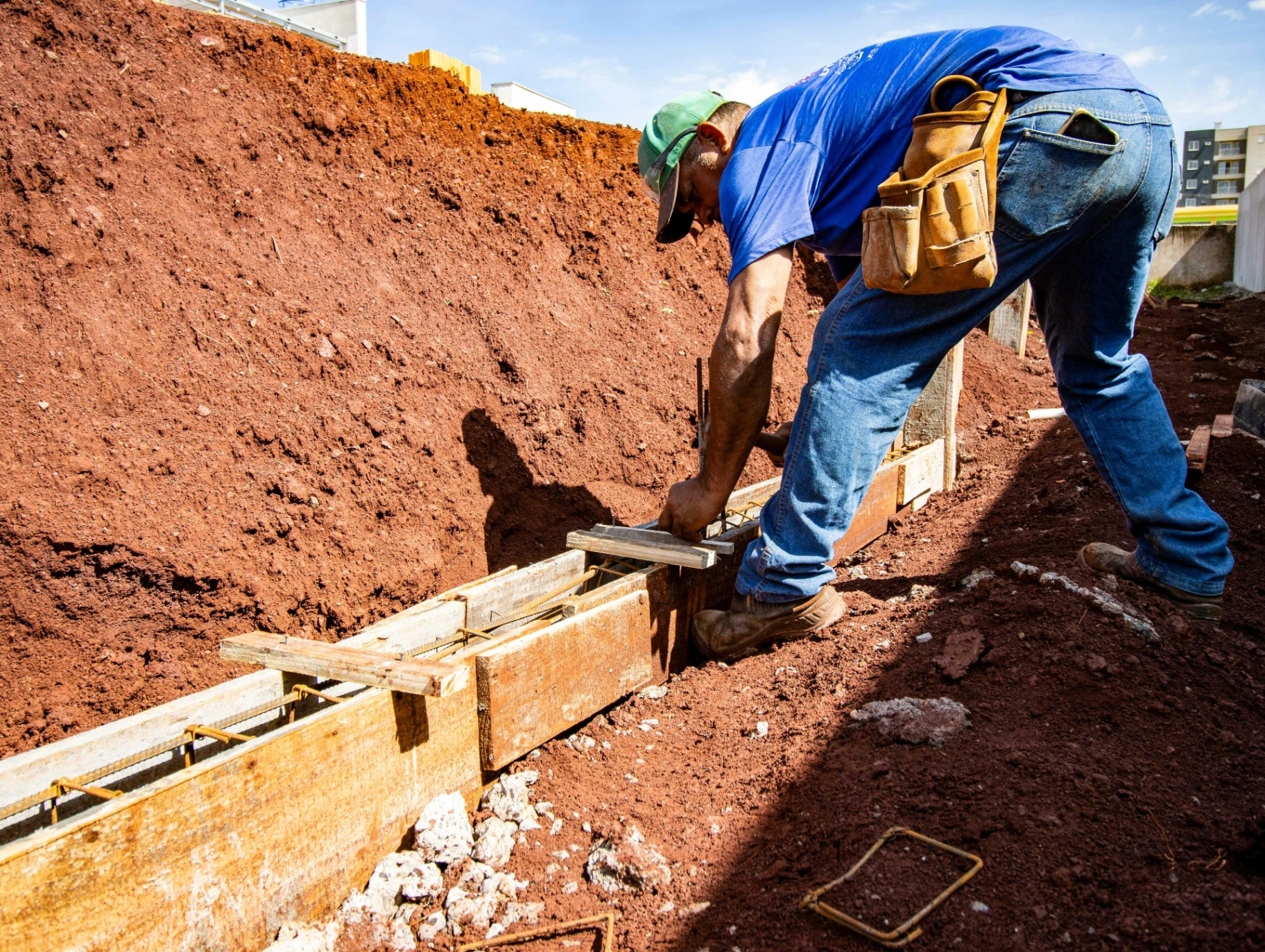
Beam and base underpinning
A reinforced beam is cast under or beside the wall, transferring weight to concrete bases founded at depth.
- UK-wide coverage and local knowledge
- 20 year remedial warranty
- Diagnostics to remedial work
What it is
Beam and base spreads the wall load over fewer, deeper points. Bases (sometimes called pads) are dug at calculated spacings, and a reinforced beam runs between them either under the existing wall (needle beam) or alongside it (offset beam).
It is a structural solution rather than a like-for-like extension of the original footing. The engineer treats the building as a load to be redistributed, not as a wall to be propped up. That changes the maths and usually means deeper, fewer interventions.
Two main configurations: a needle beam runs through openings cut in the wall and is supported on bases either side; an offset beam sits next to the wall and picks up the load through a bracket or extension. Needle beams are cleaner structurally, offset beams are easier where the wall cannot be cut into.
When it's used
Beam and base is the right call when ground conditions change along a single elevation, when load needs to be redistributed rather than simply propped up, or when the depth required for traditional mass concrete would be uneconomic. Common applications: partial subsidence under a single bay window, settled extensions tied into a main house that has not moved, free-standing garden walls leaning against the property, and long elevations where soft spots in the soil mean some sections need carrying further than others. It is also the engineer's preferred answer where loads are concentrated, for example beneath a chimney breast or a piered corner.
Choose between needle and offset configuration based on whether the wall can be cut into. Needle beams thread through openings cut in the wall and are supported on bases either side, which is structurally clean but invasive. Offset beams sit alongside the wall and pick up the load through brackets, which is friendlier to listed or decorative facades but slightly less efficient. Working space matters more than for mass concrete because the pits are larger; jobs with no rear access tend to push toward piled methods instead.
How the work runs
-
1. Engineer's design
Beam size, base spacing, and rebar schedule worked out from the soil report.
-
2. Base excavation
Pads dug to the design depth, inspected, and poured.
-
3. Beam formation
Reinforced beam cast between bases, tied into the existing structure.
-
4. Reinstatement
Backfill, drainage repairs, and external finishes restored.
Pros and cons
Pros
- Spreads load to fewer, deeper points, efficient where good ground is patchy
- Generally stronger than mass concrete for the same depth
- Suits irregular wall conditions and bay windows
- Engineer-designed end result with clear structural calculations
- Works for both load-bearing and free-standing walls
Cons
- Larger excavation per intervention than mass concrete
- Comparable duration to mass concrete (2–6 weeks)
- More expensive per linear metre
- Needle beams require cutting through the existing wall
How it compares
Every method we offer at a glance.
| Method | Time on site | Reaches | Disruption | Best for |
|---|---|---|---|---|
| Beam and base | 2 to 6 weeks | Up to 4m via deeper bases | High, large pits with significant excavation | Variable ground, bay windows, redistributing loads |
| Foam injection | 1 day for most jobs | Treats soil and slabs to 3m | Minimal, drilled ports only | Slab re-levelling, void fill, conservatory bases |
| Mass concrete | 2 to 6 weeks per elevation | Up to 3m hand-dug | High, open excavation and significant spoil | Shallow failures on traditional ground, insurance claims |
| Mini piled | 1 to 3 weeks on site | 10–15m, sometimes more | Medium, compact rigs and internal floor lifts | Deep bearing layers, made-up ground, restricted access |
| Resin injection | 1 day for most jobs | Treats soil to 3–4m via ports | Minimal, small ports and no spoil | Granular soils, intact foundations, voids and density loss |
| Screw pile | 2 to 5 days | 5–10m typical | Low, no excavation and no concrete cure | Lighter loads, time-critical jobs, conservatories |
Suitability
Copes well with variable ground along a wall, concentrated loads, and depths from one and a half to four metres. Struggles where there is no working space either side of the wall, where the wall itself cannot be cut into and an offset beam is also impractical, or where the bearing layer is so deep that bases would dwarf the beams. The diagnostic question is whether the engineer wants to extend the existing footing or design a new structural system; beam and base is the answer when the second is true.
Common questions
Get a free assessment
A surveyor will be in touch within 48 hours.