
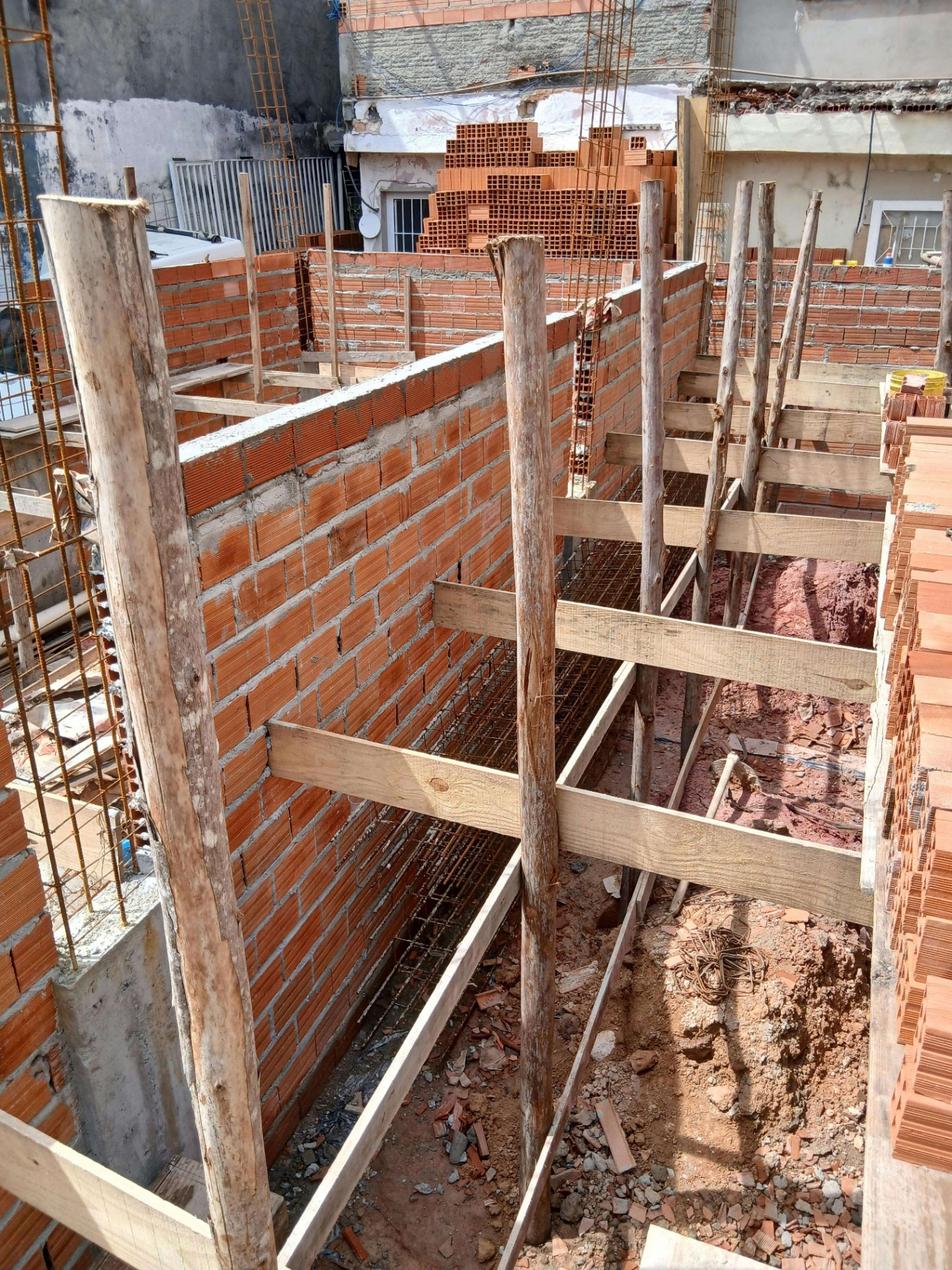
Mass concrete underpinning
Sequential excavation in short bays beneath the existing footing, then filled with concrete to transfer load to firmer ground below.
- UK-wide coverage and local knowledge
- 20 year remedial warranty
- Diagnostics to remedial work
What it is
Mass concrete underpinning is the most established way to take a shallow foundation down to better-bearing soil. The wall is supported in short, alternating sections (often called pin or bay sequence). Each bay is dug out by hand, the existing footing is dry-packed against new concrete, and the load transfers downward in stages.
It is slow work, but it is well understood by building control, insurers, and structural engineers. Almost every loss adjuster in the country has signed off mass concrete schemes, which makes it a low-friction option when an insurance claim is in the picture.
The method itself has barely changed in a hundred years. The materials have improved (modern C25/30 concrete, better waterproofing admixtures, mechanical compactors for dry-packing), but the principle of working in alternating bays so the wall is never unsupported across a long run remains the standard.
When it's used
Mass concrete is the textbook answer for shallow subsidence on Victorian and Edwardian terraces with original brick footings sitting on soft clay or made-up ground. The classic case is a hot summer, a mature tree within ten or fifteen metres of the affected wall, fresh diagonal cracking through mortar joints, and good external access to the elevation. It also suits insurance-led repairs where the loss adjuster wants a method they have signed off a hundred times before. The bearing layer needs to be reachable within roughly three metres so bays can be hand-dug safely without expensive temporary works.
If the bearing layer is more than about three metres down, the bay sizes get unwieldy, the shoring gets expensive, and the case for piled methods grows. If a tree is the cause and is staying, the depth required will usually push the same way. We see mass concrete misused on rear elevations with no realistic spoil route, where it doubles in cost simply because every barrow has to come through the kitchen. Front elevations on corner plots with a wide driveway are the cheapest scenario; rear gardens accessible only through the property are the most expensive.
How the work runs
-
1. Survey
A site visit, drainage check, and a structural review of the affected wall.
-
2. Design
Bay sequence, depth, and concrete mix agreed with your engineer and building control.
-
3. Excavation
Bays opened in a hit-and-miss pattern (typically 1m wide, every third bay) so the wall is never unsupported across a long run.
-
4. Pour and pack
Concrete poured to within 75mm of the underside, then dry-packed with a 3:1 sand-cement mix once cured.
-
5. Sign-off
Building control inspection of each stage. Final certificate issued on completion.
Pros and cons
Pros
- Universally understood by insurers, engineers, and building control
- No specialist plant required, works in tight gardens
- Predictable, well-documented method
- Long track record (over a century of use)
- A solid end result: concrete to bearing soil, full stop
Cons
- Slow on site (often 2–6 weeks for a single elevation)
- Significant excavation and spoil
- Disruption to gardens, driveways, and external finishes
- Not viable below about 3m depth without temporary works
- Requires reasonable working space alongside the wall
How it compares
Every method we offer at a glance.
| Method | Time on site | Reaches | Disruption | Best for |
|---|---|---|---|---|
| Beam and base | 2 to 6 weeks | Up to 4m via deeper bases | High, large pits with significant excavation | Variable ground, bay windows, redistributing loads |
| Foam injection | 1 day for most jobs | Treats soil and slabs to 3m | Minimal, drilled ports only | Slab re-levelling, void fill, conservatory bases |
| Mass concrete | 2 to 6 weeks per elevation | Up to 3m hand-dug | High, open excavation and significant spoil | Shallow failures on traditional ground, insurance claims |
| Mini piled | 1 to 3 weeks on site | 10–15m, sometimes more | Medium, compact rigs and internal floor lifts | Deep bearing layers, made-up ground, restricted access |
| Resin injection | 1 day for most jobs | Treats soil to 3–4m via ports | Minimal, small ports and no spoil | Granular soils, intact foundations, voids and density loss |
| Screw pile | 2 to 5 days | 5–10m typical | Low, no excavation and no concrete cure | Lighter loads, time-critical jobs, conservatories |
Suitability
Copes well with cohesive London Clay and similar plastic clays at moderate depth, predictable bay sequencing, and a building that can tolerate four to six weeks of external work. Struggles with high water tables, granular soils that collapse into open bays, restricted access where spoil cannot leave the site cleanly, and listed external finishes that are expensive to reinstate. The diagnostic question an engineer will ask first is simple: can we safely reach competent bearing within three metres without dewatering or heavy shoring? If yes, mass concrete is usually the right tool. If no, look at piled methods.
Common questions
Get a free assessment
A surveyor will be in touch within 48 hours.